
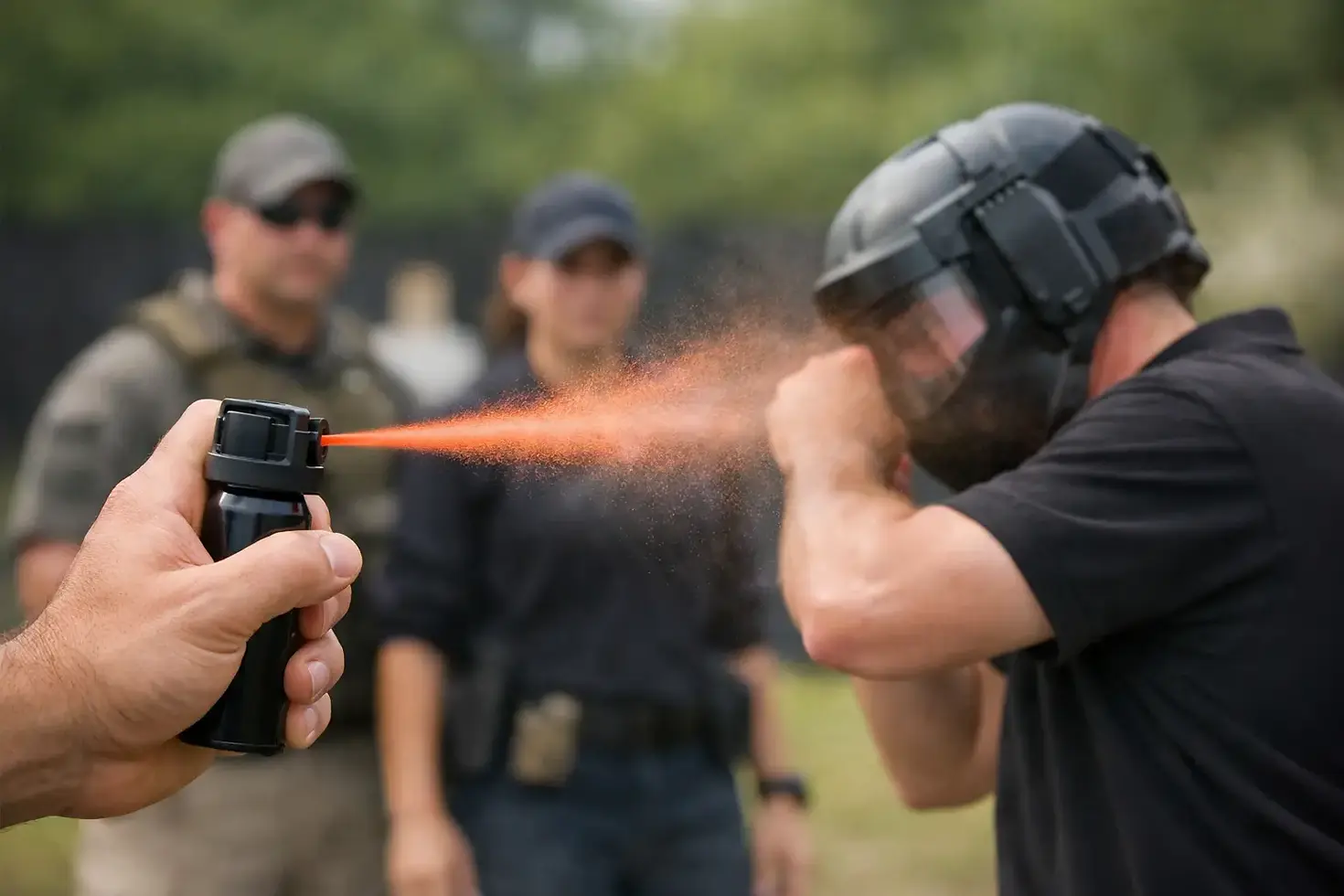
OC Pepper Spray Training Maryland for Real Readiness
A pepper spray canister is easy to buy. Making a sound decision under pressure, using it without creating a bigger problem, and knowing what to do immediately afterward take more than a purchase. OC pepper spray training Maryland residents can rely on teaches the practical judgment behind the tool, not just how to press a button.
For civilians, security personnel, and law-enforcement professionals, oleoresin capsicum, commonly called OC, is a defensive option that may help create distance from an immediate threat. It is not a guaranteed solution, and it is not a substitute for awareness, communication, escape planning, or calling for help. Good instruction treats OC as one part of a complete personal-safety plan.
Why Hands-On OC Training Matters
Most people understand the basic purpose of pepper spray: interrupt an assault long enough to disengage. The reality is less predictable. Stress affects vision, fine motor control, memory, and decision-making. Wind, confined spaces, distance, movement, and a determined subject can all affect an OC deployment.
That is why a quality course should move beyond product descriptions. Students need to work through realistic decisions: When is a situation serious enough to justify force? Is there a safe path to leave? Are bystanders close by? What happens if the spray affects the user as well as the aggressor? These questions matter whether you carry OC while walking to your car, working security, or protecting a business.
Hands-on instruction builds familiarity before an emergency. Students learn the limitations of the device, practice accessing it safely, and develop a simple post-deployment plan. That preparation helps reduce panic and supports better decisions when time is limited.
What OC Pepper Spray Training in Maryland Should Cover
A responsible OC course starts with safety, legality, and purpose. The goal is not to make students eager to use force. The goal is to help them recognize an immediate threat, take reasonable protective action, and safely transition to escape and reporting.
Legal and ethical decision-making
Pepper spray is a use-of-force tool. Carrying it does not give someone permission to use it during an argument, to settle a dispute, or to respond to rude behavior. Training should address the difference between discomfort, verbal conflict, and a credible threat of unlawful physical harm.
Maryland laws and local rules can change, and individual circumstances matter. A professional instructor can explain the importance of knowing the rules that apply where you live, work, and travel, including policies set by employers, schools, government buildings, and private property owners. Students should also understand that every use of force can be reviewed afterward by law enforcement, an employer, or a court.
The ethical standard is equally direct: use defensive tools to stop an immediate danger and get to safety, not to punish someone.
Equipment selection and safe carry
Not every OC product is designed for the same purpose. Courses may discuss spray patterns, canister sizes, safety mechanisms, expiration dates, and carry options. The best choice depends on your intended environment, your ability to carry it consistently, and your comfort operating it under stress.
A canister at the bottom of a purse may be technically available but practically useless in a fast-moving encounter. On the other hand, carrying a product where children can access it or where it can discharge accidentally creates another risk. Training helps students choose a secure, accessible location and maintain the equipment according to the manufacturer’s instructions.
Students should inspect their OC regularly for damage, corrosion, leaks, or an expired date. A neglected canister is not reliable safety equipment.
Deployment principles under stress
Safe training gives students an opportunity to handle inert training units and practice movements without introducing live OC into a classroom. The focus is on building a repeatable sequence: recognize the threat, create space if possible, access the tool, use it only when justified, move away, and seek help.
Distance, positioning, and environmental awareness are central to that sequence. Spraying in a tight hallway, vehicle, or crowded location can expose bystanders and the defender. Air movement can carry the irritant back toward the person deploying it. A course should openly address these trade-offs rather than present pepper spray as a clean or predictable answer.
Students also need to understand that OC may not stop every person immediately. An individual may remain mobile, continue aggressive behavior, or be minimally affected for a period of time. The defensive objective remains the same: create an opportunity to disengage, not remain in place to assess whether the spray “worked.”
Contamination and decontamination
Cross-contamination is one of the most overlooked parts of OC instruction. A defender may get spray on their hands, clothing, vehicle interior, or personal items. They may also experience eye irritation or respiratory discomfort after a deployment, particularly in enclosed spaces.
Training should cover basic exposure-response principles, including moving to fresh air when possible, avoiding rubbing the eyes or face, and following appropriate decontamination guidance. Students should be careful about touching other people, pets, door handles, phones, and car controls before cleaning up. If symptoms are severe, persistent, or involve medical distress, seek medical assistance promptly.
For security teams and agencies, planning should also include incident supplies, documentation procedures, and a clear process for requesting medical support when needed.
Training for Civilians, Security, and Law Enforcement
The same canister does not mean the same training needs. A civilian typically needs a straightforward program focused on lawful self-defense, awareness, safe carry, avoidance, and getting home safely. A new firearm owner may also benefit because pepper spray can offer a lower-force option for situations that do not call for a firearm.
Private security professionals need additional attention to workplace policy, professional conduct, reporting, crowd and bystander considerations, and the limits of their authority. Their role may require them to stay on scene, preserve evidence, communicate with supervisors, and coordinate with law enforcement after an incident.
Law-enforcement and agency personnel may need training aligned with departmental policy, approved equipment, reporting standards, and force-continuum requirements. Scenario-based practice and periodic recertification can be especially valuable for personnel who must make decisions while protecting the public and working with partners.
Safety First Firearms Training and Consultants approaches OC instruction as part of broader safety readiness. That means connecting defensive tools to situational awareness, medical response, communication, and the disciplined judgment required before and after any use of force.
What to Look for in an OC Instructor
Choose an instructor who treats the course as a serious safety discipline, not a product demonstration. The instructor should be able to explain the training objective in plain language, establish clear safety rules, and make room for questions from first-time students without talking down to them.
Look for hands-on practice with inert equipment, discussion of real-world limitations, and instruction that includes post-incident responsibilities. A strong course also avoids promising certainty. No defensive tool works perfectly in every environment, against every threat, or for every user.
For group training, ask whether the curriculum can be adapted to the setting. A workplace team, neighborhood group, security staff, or family group may share some concerns while facing very different risks. The right program addresses those realities without encouraging fear or careless use.
Build a Layered Personal-Safety Plan
OC works best as one layer in a plan that begins before danger appears. Awareness of entrances, exits, lighting, parking areas, and the people around you can help you avoid a problem altogether. Clear verbal boundaries, maintaining distance, and leaving early often solve situations before a defensive tool is necessary.
Your plan should also account for communication. Keep a charged phone available, tell trusted people where you are when appropriate, and know how you will contact emergency services. If you carry a firearm, understand the separate legal, practical, and safety responsibilities involved. Pepper spray training can help clarify where a less-lethal option may fit, but it does not remove the need for sound judgment with every tool you carry.
Training is most useful when it changes behavior before an emergency. Carry your equipment consistently and securely, review your plan, stay aware of your surroundings, and practice the decision to leave whenever leaving is safely available.


Comments